
Industry News

In varnish control, one of the most useful routine screening tools is Membrane Patch Colorimetry varnish potential testing, performed under ASTM D7843. The method is designed for in-service turbine oils and measures lubricant-generated insoluble color bodies by extracting them onto a membrane patch and analyzing the patch color with a spectrophotometer. The result is reported as a ΔE value in the CIELAB color space.
That technical definition is important, but on the plant floor the question is simpler: is the oil carrying degradation products that are likely to form varnish deposits and threaten equipment reliability? That is where MPC becomes valuable. It is not a direct measurement of deposited varnish inside the machine. It is a practical indication of the oil’s tendency to carry and later release insoluble varnish-related material under changing conditions.
Varnish is rarely a sudden event. It is usually the end result of oil oxidation, thermal stress, additive degradation and insoluble by-product formation. As these degradation products accumulate, they can come out of solution and deposit on machine surfaces with tighter clearances, lower flow, lower temperature zones or electrostatic influence. In turbine and circulating systems, that can affect servo valves, bearings, filters, coolers and reservoir cleanliness, leading to sluggish control response, sticking valves, heat retention and shortened oil life. Machinery-focused technical articles also point out that MPC is often used because varnish risk tends to develop before conventional oil properties look severely abnormal.
This is why varnish management should be treated as a reliability issue, not just a lubricant appearance issue. By the time deposits are visible in the system, the machine may already be paying the price in control instability, heat generation, filter distress or unplanned maintenance. A screening test like MPC is useful because it can show that the oil is moving toward a varnish-prone condition before the deposits become an operating problem.
ASTM D7843 works by first conditioning the oil sample, then diluting it with a non-polar solvent and filtering it through a 0.45-micron membrane patch. The insoluble color bodies captured on that membrane are then measured colorimetrically, and the result is expressed as ΔE. In simple terms, the darker or more intensely discolored the patch, the greater the measured presence of varnish-related insoluble material.
A key point for experienced users is that MPC is measuring insoluble color bodies, not every varnish precursor present in the oil. That means it is a very useful indicator, but not a complete varnish diagnosis on its own. It should be interpreted with the rest of the oil condition picture, especially when the machine is critical or the varnish problem is already advanced.
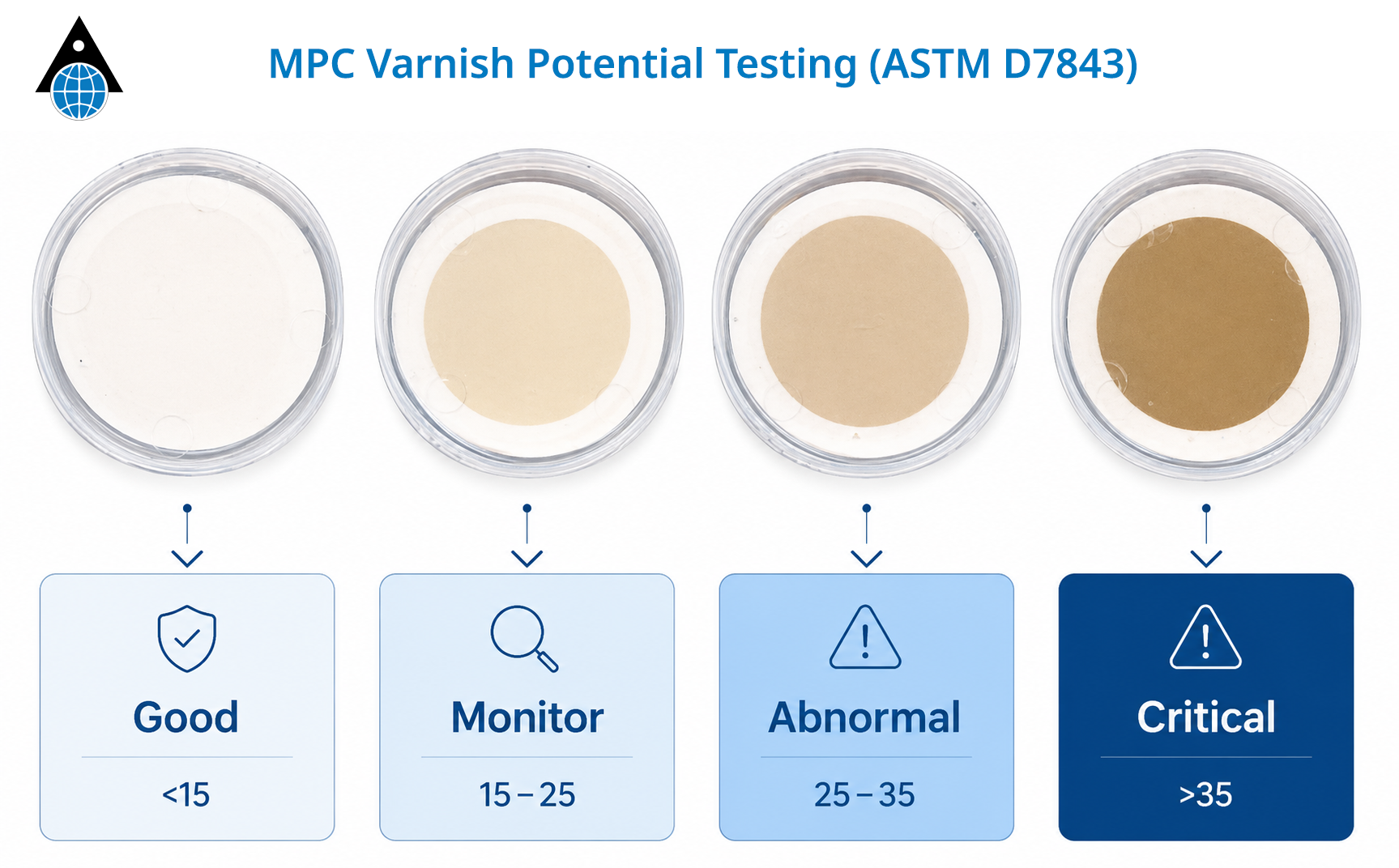
One of the most common mistakes with MPC is to treat the result as an absolute, stand-alone condemning limit. In practice, the number is best used as a trend indicator. A single elevated result may be significant, but a consistent upward trend is usually more informative because it shows that the oil is progressively accumulating insoluble degradation products. Technical commentary on the method emphasises that MPC is helpful, but the number should not be interpreted mechanically without considering the application, oil type and operating context.
To help interpret MPC results more practically, the MPC scale is often used as a general guideline for assessing a lubricant’s varnish potential. The scale is commonly divided into four categories: Good (ΔE < 15), Monitor (ΔE 15–25), Abnormal (ΔE 25–35) and Critical (ΔE > 35). As the MPC value increases, it generally indicates a higher concentration of varnish-related insoluble degradation products and a greater tendency for the lubricant to form harmful varnish deposits within the system.
The main strength of ASTM D7843 is that it provides a practical early warning of varnish tendency in in-service turbine oils. It is relatively straightforward, widely recognized and standardized, which makes it useful for trending over time and incorporating into a condition-monitoring program. For critical turbine systems, some industry guidance has even recommended frequent MPC monitoring because varnish-related failures can be severe and difficult to diagnose after the fact.
It is especially useful where the goal is to detect the onset of varnish risk before it develops into servo-valve sticking, filter plugging or control instability. In that role, MPC serves the same function as many good reliability tests: it helps the team intervene while the issue is still manageable.
A stronger varnish assessment program usually includes other condition-monitoring tools such as RPVOT/oxidation stability, acid number, remaining antioxidant tests such as RULER, particle/debris analysis, and in some cases, enhanced varnish-related methods that look at both soluble and insoluble material. Industry sources discussing varnish analysis routinely position MPC as one part of a broader varnish control strategy, not the entire strategy.
For plant reliability teams, the practical takeaway is simple: if MPC is rising, ask broader questions. Is the oil oxidizing? Are antioxidants depleted? Is there heat stress, contamination, poor filtration or electrostatic charging in the system? A useful MPC result should trigger investigation, not just reporting.
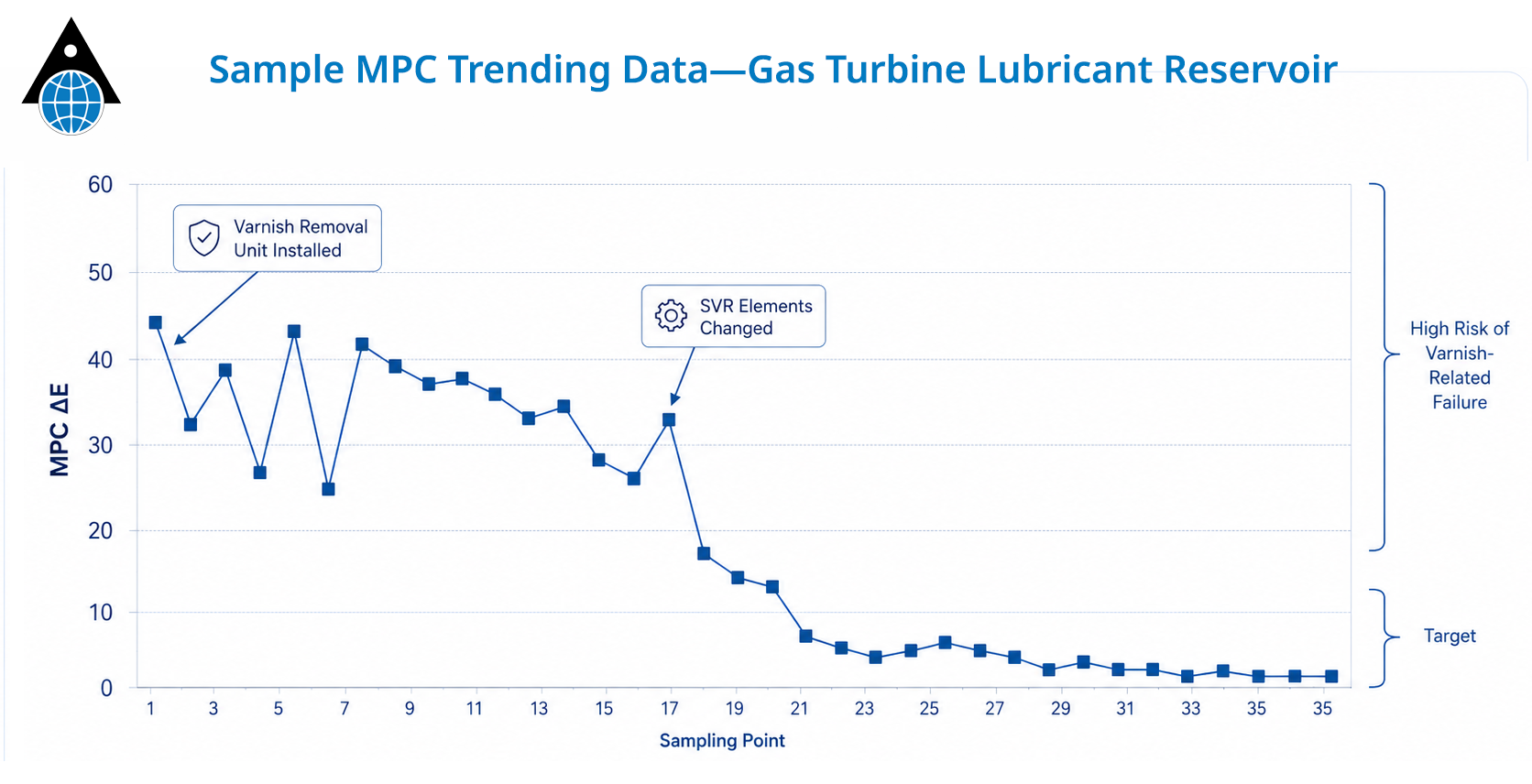
MPC is most valuable in critical turbine and circulating oil systems, especially where varnish has historically been a concern or where the equipment depends on clean hydraulic control performance. It is particularly useful when the machine is still operating, but early signs such as sticky valves, shortened filter life, elevated operating temperature or inconsistent control response suggest that varnish may be developing. In such cases, MPC can help confirm that the oil is part of the problem.
It is also useful after corrective action. If a plant changes filtration strategy, improves contamination control, installs varnish removal technology or replaces the oil, MPC trending can help show whether the condition is stabilizing or drifting back in the wrong direction.
Atlas Lab supports industrial users with MPC Varnish Potential Testing (ASTM D7843) as part of a broader condition-monitoring and lubricant-health approach. For facilities running turbine and critical circulating systems, this kind of testing helps identify varnish risk early, before deposit-related issues begin affecting control performance, filter life and overall system reliability. When varnish is caught early, plants are in a far better position to plan corrective action rather than react to forced outages.
Beyond generating a number, Atlas Lab helps place the result in context. That means looking at MPC alongside the wider oil condition picture and helping clients understand whether the issue points to oxidation stress, contamination, additive depletion or an emerging deposit-control problem. This supports better maintenance planning, cleaner systems, improved equipment responsiveness and more efficient operation of critical assets.
With accurate testing, disciplined sample handling and practical interpretation, Atlas Lab helps clients move from reactive varnish troubleshooting to proactive varnish risk management.
If your plant is operating critical turbine or circulating oil systems, MPC varnish potential testing can be a valuable part of protecting equipment reliability and improving industrial efficiency. Atlas Lab provides professional testing support to help identify varnish risk, monitor oil condition and guide timely corrective action.
Connect with Atlas Lab to strengthen your varnish monitoring program and keep your systems cleaner, more responsive and more reliable.
Phone :+91 9324631646
WhatsApp : +91 9324631646
Email : contact@atlaslab.in

The cement industry operates under some of the harshest conditions in industrial manufacturing. Equipment such as rotary kilns, vertical roller mills,
Read more about Lube Oil Testing for the Cement Industry
The steel industry operates some of the most demanding and high-load machinery in the industrial sector. Equipment such as blast furnaces,
Read more about Lube Oil Testing for the Steel Industry